nt3d#
A small 3D scene engine for Go programs that draw in the terminal, the browser, or a native GPU window. Build a scene of meshes, points, lines, Gaussians, and textures, point a camera at it, and nt3d renders it on the GPU with WebGPU, in software when there is no GPU, or as wireframe text when there are no graphics at all.
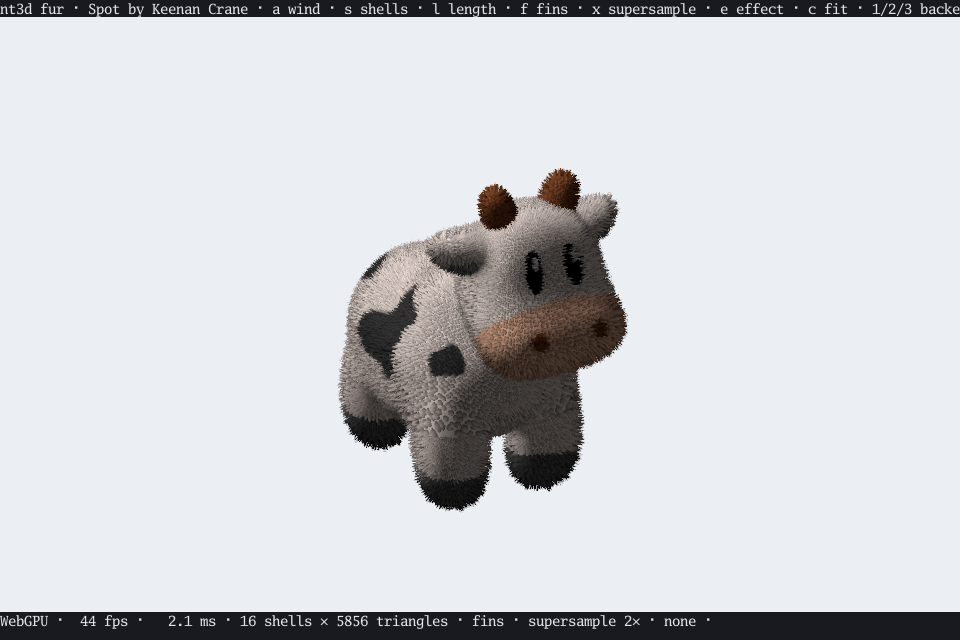
Try the demos in your browser → Every demo in the gallery is the same Go program you can run in a terminal, compiled to WebAssembly.
A first look#
scene := nt3d.NewScene()
ball, _ := nt3d.BuildSphere(nt3d.Sphere{Radius: .6, Color: orange})
scene.SetGeometry("ball", ball)

view := nt3dwidget.New(scene, 80, 24) // a Bubble Tea model you can drag to orbit
Getting started turns that into a complete program.
What it does#
- A scene graph of named nodes with transforms,
float64camera-relative world origins (Scene.SetNodeOrigin), visibility, instanced shared geometry, in-place vertex updates, and distance-tiered level of detail (Scene.SetLOD), so a forest of thousands of trees costs one mesh per tier. - Declarative camera paths: pure-
float64, zero-allocation camera trajectories (nt3d/camand YAML/JSONnt3d/cam/spec) with arc-length splines, Bishop parallel transport,C¹SQUAD orientation, causal look crossfades, camera switching, and 3D frustum debug overlays. - Clustered level of detail & spatial indexing: cluster million-point clouds, instances, and labels once (
nt3d/clod) and cull/thin per frame on CPU or WebGPU compute, or query moving boxes with a generic dynamic AABB tree (nt3d/aabbtree). - Three renderers that agree: WebGPU (including direct swapchain rendering via
GPUSession), a software rasterizer that draws the same picture, and wireframe for any terminal. - Materials, lighting & effects: Cook-Torrance GGX PBR with Clearcoat, Sheen, packed ORM maps, and HDR emissive glow alongside Blinn-Phong; Radiance
.hdrand LDR image-based lighting; directional, point, andSpotLightshadow maps; mipmapped and normal-mapped textures; Weighted Blended Order-Independent Transparency (Frame.OIT) and scene refraction; 4× WebGPU MSAA and HDR post-processing (SSAO, bloom, tone mapping, vignette); cel/toon shading with silhouette and crease ink;VertexDisplacementandMaterialShaderhooks; shell fur (nt3d/fur); and Gerstner water (nt3d/water). - Meshes, glTF animation & Gaussian splats: STL, OBJ, 3MF, PLY, glTF/GLB (skins, morphs, cameras, PBR extensions, and
KHR_lights_punctual), and 3DGS splats (.ply,.spz,.sog), decoded safely within memory and size limits. - A Bubble Tea widget that handles camera controls, background-indexed picking, world-anchored labels, Kitty graphics, and falling back when the GPU or the terminal can’t keep up.
Where to look#
- Guide: from a first program through scenes, materials, mesh files, and the widget.
- Demos: what each gallery demo shows, and how to run it.
- API reference: every type and function is documented in the source;
go doc nimbleterminal.dev/nt3dreads it.
Source#
nt3d is MIT-licensed, copyright Neomantra Corp. The source and issues are on GitHub.